

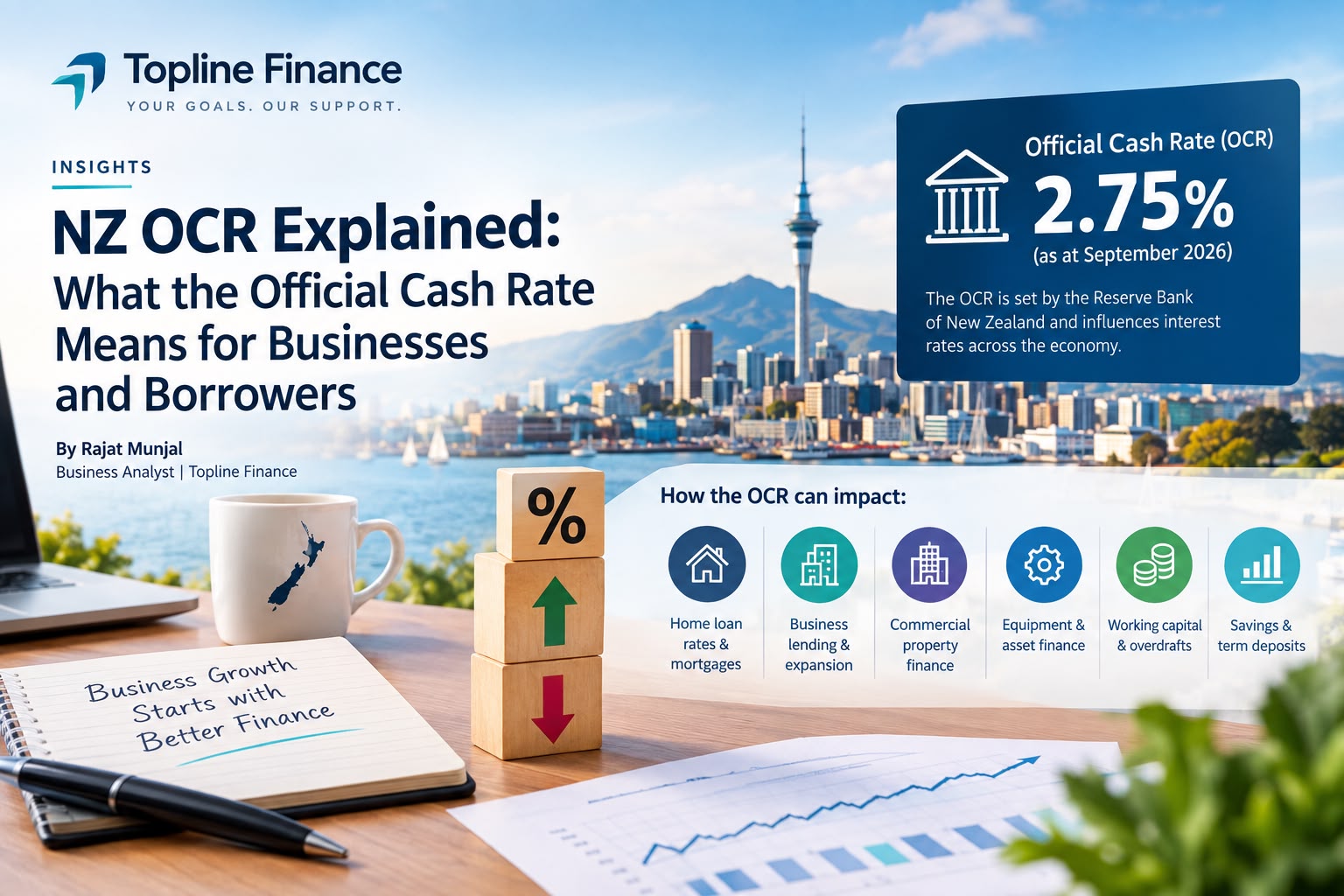
The Official Cash Rate (OCR) in New Zealand is one of the most important indicators for understanding the country’s interest-rate environment.
Although the OCR is set by the Reserve Bank of New Zealand (RBNZ), its impact extends well beyond monetary policy. Changes in the OCR can influence mortgage rates, business lending rates, investment decisions, consumer spending and the overall cost of finance in New Zealand.
For business owners and borrowers, understanding the NZ OCR can help when making decisions about borrowing, refinancing, expansion and investment.
As at September 2026, the RBNZ’s Official Cash Rate is 2.75%.
But what does that actually mean for a New Zealand business?
What is the Official Cash Rate (OCR)?
The Official Cash Rate, commonly referred to as the OCR, is the interest rate set by the Reserve Bank of New Zealand.
The RBNZ uses the OCR as one of its key monetary policy tools to influence economic activity and inflation.
When the OCR changes, it can affect the broader cost of borrowing and saving across the New Zealand economy.
This can eventually flow through to:
- Business loan interest rates
- Residential mortgage rates
- Commercial property lending
- Equipment and asset finance
- Working capital facilities
- Overdrafts and revolving credit
- Savings and deposit rates
It is important to understand that the OCR does not directly determine the interest rate you will receive from a lender.
Individual lending rates depend on a range of factors, including the type of finance, loan structure, security, borrower profile, financial strength and lender risk assessment.
How does the OCR affect interest rates in New Zealand?
The relationship between the OCR and lending rates is not always immediate or one-to-one.
However, changes in the OCR can influence funding costs and broader market interest rates, which can then affect the rates offered by banks and other lenders.
When the OCR increases
A higher OCR generally creates a tighter borrowing environment.
Businesses and households may face higher interest costs, which can affect:
- Loan repayments
- Business cash flow
- Mortgage affordability
- Investment decisions
- Consumer spending
- Business expansion plans
For a business with significant debt, even a relatively small change in interest rates can have a meaningful impact on annual finance costs.
When the OCR decreases
A lower OCR can contribute to a more supportive borrowing environment.
Lower interest rates may improve affordability for some borrowers and create opportunities for businesses to consider:
- Expansion
- Equipment purchases
- Commercial property
- Business acquisitions
- Refinancing
- Working capital
- New investment
However, a lower OCR does not automatically mean that every borrower will qualify for cheaper finance.
Lenders still assess the individual application and the underlying financial position of the borrower.
How does the OCR affect business loans in NZ?
For New Zealand businesses, one of the most important effects of the OCR is its potential impact on the cost of business borrowing.
Consider a business that has borrowed $500,000.
If the interest rate applicable to that borrowing changes, the annual interest cost can change significantly.
This is why businesses should look beyond the headline interest rate and consider the broader question:
Can the business comfortably service its debt under different interest-rate scenarios?
A well-prepared finance proposal should demonstrate this clearly.
Does the OCR affect your borrowing capacity?
It can.
When lenders assess a loan application, they generally look at the borrower’s ability to meet repayments.
Higher interest rates can increase debt-servicing costs, potentially reducing the amount a borrower can comfortably support.
For businesses, lenders may consider:
- Revenue
- Profitability
- Historical financial performance
- Cash flow
- Existing debt
- Proposed borrowing
- Security
- Business structure
- Industry conditions
- The purpose of the loan
- Management experience
This means that the OCR is only one part of the overall lending picture.
Two businesses seeking the same amount of finance may receive different lending outcomes because their financial positions, security and risk profiles are different.
OCR and commercial property finance
The OCR can be particularly relevant to commercial property finance in New Zealand because commercial property transactions often involve substantial borrowing.
Changes in interest rates can affect:
- Debt-servicing costs
- Property cash flow
- Investment returns
- Refinancing decisions
- Acquisition affordability
- Business expansion plans
For a property investor or business owner, it is therefore important to consider not only the current interest rate but also the resilience of the investment if rates remain higher than expected.
A strong financial model can help demonstrate how the proposed borrowing performs under different scenarios.
OCR and residential property lending
The OCR also has an important relationship with the residential property market.
Changes in interest rates can affect mortgage repayments and borrowing affordability.
For prospective home buyers and property investors, this can influence how much debt they are comfortable taking on.
For existing borrowers, changes in interest rates may also lead to decisions around:
- Refinancing
- Loan restructuring
- Fixed versus floating rates
- Repayment strategies
- Using available equity
However, the OCR should not be viewed in isolation. Income, existing commitments, deposit or equity, property value and servicing capacity are also important considerations.
Should businesses wait for the OCR to fall before borrowing?
There is no universal answer.
One of the risks of waiting for the “perfect” interest rate is that a business opportunity may be lost.
For example, if finance is being considered for an equipment purchase that will significantly increase productivity, delaying the investment for a small potential reduction in interest rates may not necessarily make financial sense.
Instead, business owners should consider the overall return and purpose of the borrowing.
Ask:
- What will the finance achieve?
- Will the investment increase revenue?
- Will it reduce operating costs?
- Can the business comfortably service the debt?
- What happens if interest rates remain higher for longer?
- Is there sufficient cash-flow capacity?
- Does the proposed loan structure match the purpose of the borrowing?
The right borrowing decision is usually based on the overall economics of the opportunity—not simply on trying to predict the next OCR movement.
How can businesses prepare for changing interest rates?
Businesses cannot control the OCR, but they can control how well prepared they are.
Some practical steps include:
- Understand your cash flow
Know how much cash the business generates and how much is required to meet existing commitments.
- Review existing debt
Understand your current loans, interest rates, repayment structures and refinancing dates.
- Model different interest rates
Consider what would happen to cash flow if borrowing costs increased.
- Maintain financial records
Up-to-date financial statements and management accounts can make it easier to assess the business’s current position.
- Understand the purpose of new borrowing
A lender should be able to clearly see why the money is required and how it will benefit the business.
- Prepare a strong finance proposal
A clear business plan, financial forecasts and supporting information can help present the application in a structured and credible way.
What does the OCR mean for your next finance application?
The most important point is that the OCR is a market indicator—not a lending decision.
A lender will still want to understand your individual financial circumstances and the fundamentals behind the application.
For example, if you are seeking:
- Business finance
- Commercial property finance
- Residential property finance
- Equipment finance
- Working capital
- Business acquisition finance
- Refinancing
your application should clearly explain the purpose of the funding and demonstrate how the proposed borrowing can be supported.
This is where having a lender-ready proposal can make a difference.
Building a lender-ready finance proposal
At Topline Finance, we focus on helping clients present their financial position in a clear, structured and professional manner.
Our analysts can assist with the preparation of business plans, financial reports and supporting analysis for commercial and residential lending applications.
A strong proposal can bring together:
- Business background
- Funding requirements
- Financial performance
- Cash-flow forecasts
- Existing commitments
- Proposed use of funds
- Security information
- Repayment considerations
- Business and market analysis
The objective is simple: give the lender a clear picture of the borrower, the opportunity and the ability to service the proposed finance.
Final thoughts: Understanding the NZ OCR
The New Zealand OCR plays an important role in the country’s financial environment.
Changes in the Official Cash Rate can influence borrowing costs, household spending, business investment and the broader lending market.
But for a business owner, knowing the current OCR is only the starting point.
The more important question is:
How does the current interest-rate environment affect my business, my cash flow and my borrowing plans?
Whether you are considering business finance, commercial property, residential lending, refinancing or an investment, a well-structured financial assessment can help you make a more informed decision.
At Topline Finance, we help businesses and borrowers turn financial information into clear, lender-ready proposals.
Because a strong finance application is not just about asking for funding. It’s about clearly demonstrating why the funding makes sense.