

What borrowers and businesses should expect – and how to prepare for the next phase of lending
By Rajat Munjal, Analyst | Topline Finance
The New Zealand lending market is entering an interesting phase.
For clients, the question is no longer simply “What interest rate can I get?” It is increasingly becoming:
“How will lenders assess my application in the future, and what can I do now to be ready?”
Interest rates, household affordability, business conditions, property values, income stability and lending policies are all influencing borrowing decisions. At the same time, recent RBNZ data shows that different parts of the lending market are moving in different directions.
From a client’s perspective, this means preparation may become just as important as the loan product itself.
The lending market is changing
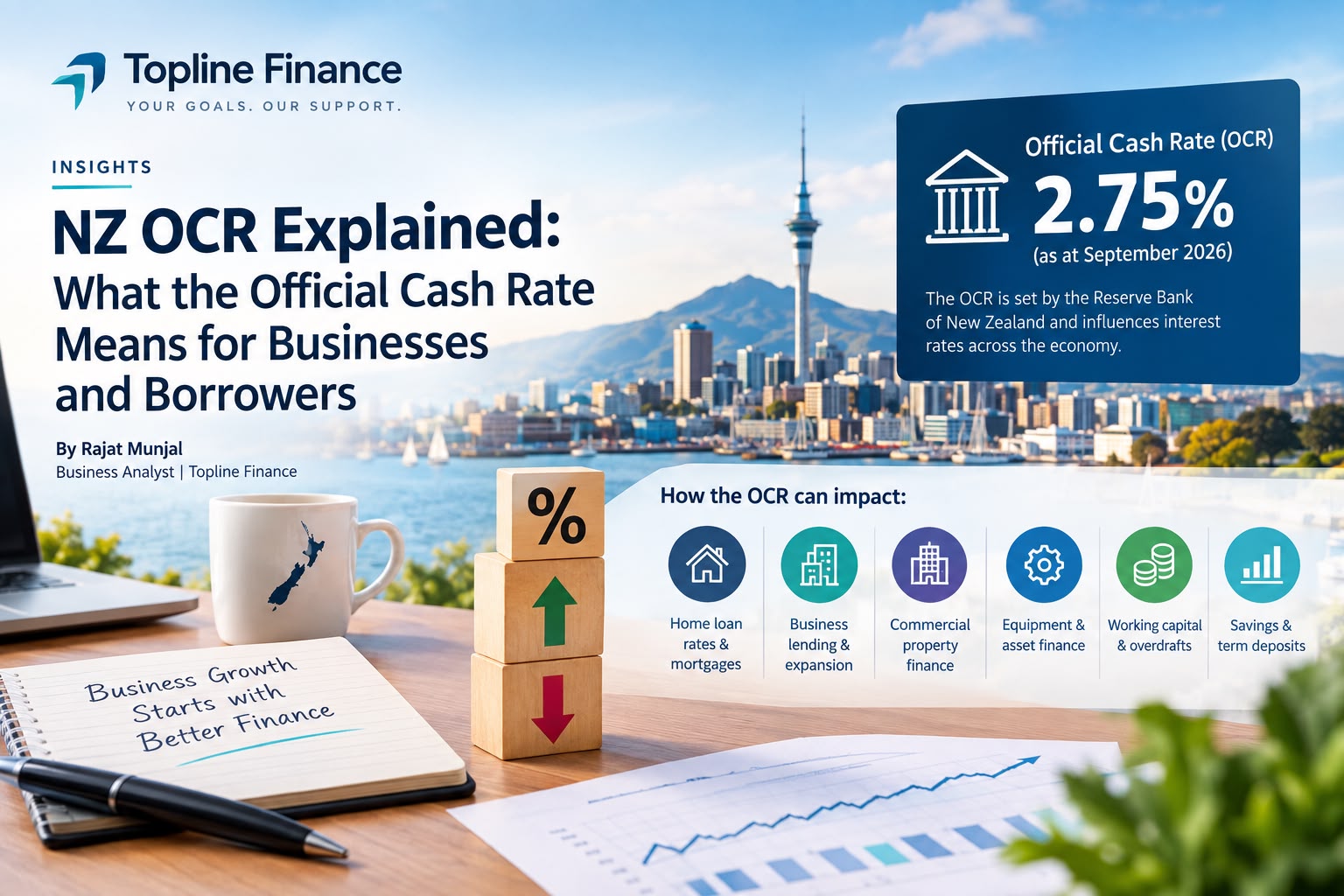
The Reserve Bank of New Zealand increased the Official Cash Rate to 2.75% in September 2026. RBNZ also noted that higher wholesale interest rates have recently flowed through to higher mortgage and business lending rates. (Reserve Bank of New Zealand)
This creates a more complex environment for borrowers.
A client considering a mortgage, refinancing, property purchase or business loan needs to think beyond today’s advertised interest rate.
The future lending equation
Income + affordability + deposit/equity + credit profile + financial documentation + lender policy
Stronger application
More informed borrowing decision
Greater ability to respond to changing market conditions
What the numbers are telling us
Recent RBNZ statistics provide some useful insight into how lending behaviour is changing.
Residential mortgage lending
New residential mortgage lending was:
Period New residential mortgage lending
July 2025 $9.035 billion
July 2026 $7.853 billion
Change ≈ -13.1%
RBNZ data also shows that first-home-buyer lending was $1.751 billion in July 2025 compared with $1.580 billion in July 2026, while investor lending decreased from $1.914 billion to $1.481 billion over the same period. (Reserve Bank of New Zealand)
Client perspective: borrowers should not assume that a lower or changing interest-rate environment automatically means easier lending. Lenders continue to assess affordability, debt levels, deposit/equity and the overall strength of the application.
Business lending tells another story
The business lending market has shown a different trend.
Total bank business loans increased from:
$127.3 billion July 2025 to $133.1 billion July 2026
That’s approximately 4.6% growth over the year. SME lending also increased from $79.5 billion to $84.3 billion over the same period. (Reserve Bank of New Zealand)
What this could mean for clients
For business owners, funding opportunities may increasingly depend on demonstrating:
- Sustainable revenue
- Strong cash-flow management
- Realistic forecasts
- Debt-servicing capacity
- Clear business purpose
- Quality financial statements
- A well-structured funding proposal
The future business-loan conversation is therefore likely to involve more than simply asking how much a business wants to borrow.
It is about demonstrating why the funding makes sense and how it will be serviced.
Lending Market Snapshot
July 2025 → July 2026
Residential mortgage lending
$9.04B → $7.85B
Approx. -13.1%
Bank business lending
$127.26B → $133.11B
Approx. +4.6%
OCR
2.75% as at September 2026
These figures demonstrate that the New Zealand lending market is not moving in one single direction. Residential mortgage activity and business lending can respond differently to economic conditions, borrower demand and lender requirements. (Reserve Bank of New Zealand)

What does the future loan market look like from a client’s perspective?
Rather than predicting a single outcome, it is useful to consider several trends that borrowers may encounter.
- Affordability will remain important
A borrower may have a strong income but still need to demonstrate that the proposed loan is affordable after considering existing commitments and living expenses.
As RBNZ has noted, household income growth has remained relatively weak and higher mortgage rates can gradually increase household debt-servicing costs as borrowers refix. (Reserve Bank of New Zealand)
Client takeaway:
Know your numbers before applying.
Understanding your income, expenses, existing debt and potential repayments can help you approach lenders with realistic expectations.
- Documentation will matter more
One of the biggest changes from a client’s perspective is the increasing importance of a complete and credible application.
For residential borrowers, this may include:
- Proof of income
- Bank statements
- Existing loan information
- Deposit/equity evidence
- Property information
- Living-expense information
For business borrowers, the information may extend to:
- Financial statements
- Management accounts
- Business plans
- Cash-flow forecasts
- Tax information
- Existing business debt
- Asset and liability information
The simple principle:
The stronger the evidence behind the application, the easier it is for a lender to understand the client’s financial position.
- Business borrowers may need to tell a clearer story
A business loan application should answer three fundamental questions:
Why do you need the money?
For example:
Expansion | Equipment | Property | Working Capital | Acquisition | Refinancing
How will the money be used?
A clear breakdown of the proposed funding gives the lender a better understanding of the transaction.
How will the loan be repaid?
This is where realistic revenue assumptions, cash-flow forecasts and servicing calculations become important.
- Clients may become more focused on structure
The future loan conversation is unlikely to be only about the headline interest rate.
Clients may increasingly consider:
Interest rate
Loan term
Fixed vs floating structure
Repayment flexibility
Fees
Early repayment considerations
Overall affordability
The appropriate structure will depend on the client’s individual circumstances and lender criteria.
- Refinancing will remain an important conversation
As borrowers move through different fixed-rate periods, refinancing can become an opportunity to review the wider financial position.
A refinancing discussion can consider:
- Current interest rate
- Remaining loan balance
- Existing loan structure
- Property position
- Income changes
- Other debts
- Future borrowing requirements
Instead of asking only:
“Can I get a lower rate?”
clients may increasingly ask:
“Does my current lending structure still make sense for my next three to five years?”
The future borrower: prepared, informed and financially organised
From an analyst’s perspective, one of the clearest lessons from the changing lending environment is that loan preparation matters.
A client who starts preparing only when they need the money may have fewer options than a client who understands their financial position in advance.
A future-ready borrower should understand:
- Income
What is your reliable income?
- Expenses
What does your actual monthly cash flow look like?
- Existing debt
What commitments are already being serviced?
- Equity / deposit
What contribution can you make?
- Purpose
Why is the borrowing required?
- Repayment strategy
How will the debt be serviced?
- Future plans
Will you need additional funding in the next 12–36 months?
⸻
A simple client-readiness framework
TODAY
Review your financial position
NEXT
Understand your borrowing capacity
THEN
Prepare supporting documents
STRUCTURE
Identify appropriate lending options
APPLY
Present a clear, complete and credible proposal
FUTURE
Review your lending structure as circumstances change
What this means for Topline Finance clients
At Topline Finance, we believe the lending conversation should begin before the application reaches the lender.
Our role is to help clients understand how their financial position can be presented clearly and professionally.
For business and property-related funding, this can include preparing:
- Business plans
- Financial analysis
- Cash-flow forecasts
- Supporting financial reports
- Funding summaries
- Lender-ready proposals
The objective is not simply to put numbers on a page.
It is to help present the financial story behind the borrowing request.
Looking ahead
The New Zealand lending market will continue to be influenced by interest rates, inflation, employment, household finances, property conditions, business confidence and lender policies.
The current data already shows that different segments of the market are behaving differently: residential mortgage lending was lower year-on-year in July 2026, while bank business lending was higher. (Reserve Bank of New Zealand)
For clients, the practical lesson is straightforward:
Don’t wait for the market to become perfect. Prepare for the market you are actually entering.
A well-prepared borrower can better understand their options, identify potential challenges early and have a clearer conversation with lenders.
At Topline Finance, our focus is on helping clients turn financial information into clear, structured and lender-ready proposals.